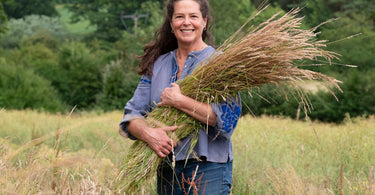
Lead image, Ruby Harvesting Wild Grass, Photography by Sam Green
Amy: Hi Ruby, firstly, thank you so much for agreeing to this interview. At AARVEN we are basket obsessed. Having personally spent many years working with weaving communities across Africa and having recently moved to the Northern Irish countryside where foraging opportunities are plentiful, your book ‘Wild Basketry’ excited me on multiple levels.
From your book I can see you have travelled extensively. Whenever I travel I’m fascinated by the similarities between traditional art and craft practices, for example the use of dots in both aboriginal artwork and that of the tribal communities of central India.
As someone who has also spent time with traditional communities around the world, have you noticed this cross pollination in basketry and has it influenced your own practice?
Ruby: What I’ve observed is how the indigenous basketmaking technologies of a place develop directly from the flora of the region, coupled with the needs of the people. Whether that’s grain storage vessels, the structures of human dwellings, boats, hats etc.
It’s influenced me in encouraging the exploration of native flora and indigenous basketry technologies of these lands.
I was very fortunate to have been a team member, for several years, of an archaeology and museum partnership, where one of the facets of our work was constructing prehistoric-style dwellings, based on archaeological records.
The dwelling we created that I loved most was made entirely from local plants, just as it would have been in Mesolithic times: a tall, round, woven frame of ash and hazel, thatched from top to bottom with phragmites reeds held in place with hazel rods and spars. It was such a beautiful space to be inside.

Photography by Ruby Taylor
Amy: How wonderful to create a dwelling from such a large variety of native materials, I can imagine how beautiful that must have been. I often feel that weaving is generally associated with specific materials such as willow and rattan but from your book I was amazed to see that you can weave cord from so many plants. I was surprised and delighted that you can make cordage from daffodil stems which grow in abundance in the fields around my home. In Kenya I’ve see our weavers make cordage from sisal and in Ghana from Veta Vera (elephant grass).
Which material do you enjoy working with the most and in your travels is there anything that’s made you rethink weaving and the materials you can use either through necessity or local abundance?
Ruby: I genuinely enjoy working with all the plants, they all have such differing characteristics.
Recently I’ve been working with wild grasses quite a bit. They are lovely for their smell, they remind me of hay meadows from when I was growing up in the countryside.
It’s relatively abundant near me and easy to harvest, as well as being very beautiful to coil, plait and twist. My Dad grew up on a mixed farm in South Oxfordshire just as mechanisation was taking over manual farmwork; he remembers hay ricks being tied down with thick ropes twisted out of the hay itself; I love this connection through him.
Many years ago, before I began weaving, I saw huts being made of huge bundles of grass tied down over simple stick frames in South West Ethiopia. It was eye-opening to witness such beautiful structures being made from plants that grew in abundance: so local, so ergonomic, so harmonious and so sustainable.

Ruby harvesting reed mace, Photography by Megan West
Amy: In your book you interview other artists working in the field of weaving who are pushing the boundaries of their craft. What’s exciting you the most right now and is there anyone / thing that is inspiring you at the moment?
Ruby: I recently went to see Andy Goldsworthy’s exhibition ‘Fifty Years’. I was so struck by the visceral experience of the exhibition. His work comes from years of intimacy with the land, both as a farm worker and an artist, immersed in the landscape and the elements. He recognises himself / ourselves as nature, not as separate from it. To create his art he collaborates with the natural world, you can see a deep understanding and dialogue there, it touched me deeply.
Amy: We are living in a world where access to nature is becoming increasingly scarce. What would your advice be to people living in urban environments wanting to connect with nature and try weaving for the first time?
Ruby: There are lots of plants that grow in marginal areas of allotments and gardens, even small gardens, that you can weave with. In my book Wild Basketry I mention daffodil stems, iris leaves, brambles, grass, nettles. You don’t need a big open wild landscape to roam through for harvesting, many weavable plants are very close to home.

Photography by Ruby Taylor
Amy: We loved reading about your retreats at your home in East Sussex and would like to learn more about these. Where can people go to find out more and is there anything you have coming up that you would like to tell our readers about?
Ruby: My schedule of woodland courses is here on my website https://nativehands.co.uk/
This year I’m particularly looking forward to teaching a course making nettle fibre net bags. And also a woven trugs course, made from sweet chestnut bark, which we’ll harvest on the day from the woodland.
As well as working with plants for basketmaking I also teach wild pottery where we dig clay onsite and then fire the pots in an open fire.
It’s just so gorgeous to be out in the beautiful woods supporting people to connect and create.
I’ll be part of Sussex Craft Week, June 20-28, exhibiting in Lewes and offering a woodland studio safari.
Details about Sussex Craft Week are here: www.rosamagazine.co.uk
I’m also on Instagram https://www.instagram.com/nativehands.uk/

Photography by Ruby Taylor
Amy: Thank you so much Ruby. It's been a pleasure talking with you and I'm sure our readers will feel as inspired as I am to get weaving!
Ruby's book 'Wild Basketry' is available to purchase online here.
EXCLUSIVE READER OFFER - Ruby has very kindly offered 10% off her woodland courses until 31st May* to subscribers of our newsletter. Sign up by midday on Thursday 24th April 2026 to receive your exclusive discount code in the next AARVEN newsletter.
*T&C's - Valid on Wild Basketry courses only via Native Hands. Excludes wild pottery and any other offers (including weekend promotions).
Use code at checkout by 23:59 (BST) 31st May 2026. Subject to availability. No cash alternative. Standard booking and cancellation terms apply.
